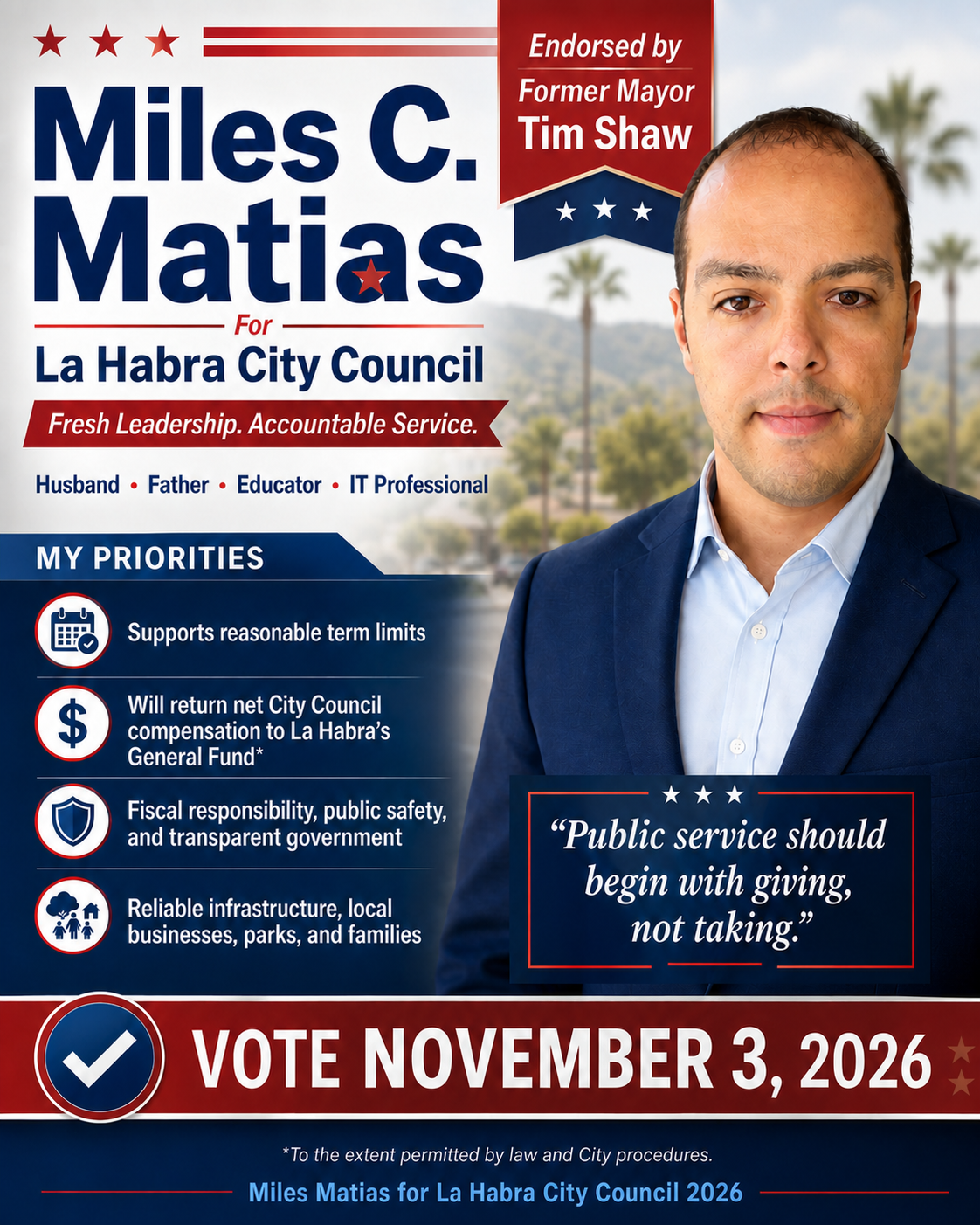
Straight answers drawn from questions La Habra residents have asked me publicly. I believe voters deserve to know not only what I support, but how I would approach the work.
Who is Miles Matias?
I am a La Habra resident, husband, father of three young children—ages one month, two years, and three-and-a-half years—an information technology professional, and a college instructor. I was born in the Bronx and moved to La Habra with my family when I was three years old after my father became an LAPD police officer. I have called La Habra home for more than 30 years.
Education: I earned six associate degrees from Rio Hondo College: an AA in Economics; an AS and AA in Business Administration; and AAs in Spanish, Human Behavior, and General Studies. I also earned a Bachelor of Science in Information Technology and a Master of Science in Information Technology Management from Western Governors University.
Continuing to learn: I am pursuing an MBA and plan to pursue a Doctor of Business Administration (DBA) in the future. I believe education, disciplined study, and lifelong learning help prepare me to examine complex issues and serve La Habra residents thoughtfully.
Why are you running for City Council?
I am running because I genuinely want to see La Habra prosper. I want residents to have a fresh voice at City Hall—one that listens, asks difficult questions, explains decisions clearly, protects essential services, and treats public office as a temporary responsibility to serve.
Is the City Council race partisan?
La Habra City Council is a nonpartisan office. My outlook is generally conservative: I believe in public safety, fiscal responsibility, limited and accountable government, strong core services, competitive bidding, personal responsibility, and respect for taxpayers.
Why do you support term limits?
Reasonable term limits make room for fresh perspectives, new ideas, and broader participation. Experience matters, but no elected seat should become permanent. La Habra has many capable residents who deserve an opportunity to contribute, and elected leaders should build a foundation for the next generation of public servants.
What is your position on City Council compensation?
I intend to return my City Council compensation to La Habra’s General Fund, subject to applicable legal, tax, payroll, and City procedures. The final mechanism must be reviewed carefully before implementation. My principle is simple: public service should begin with giving, not personal financial benefit.
What experience would you bring to the Council?
I work as an information technology specialist and as an adjunct college professor. My work requires problem-solving, careful review of complicated systems, communication with people from different backgrounds, and accountability for results. I also understand what it means to balance work, family, and financial responsibilities like many La Habra residents do every day.
What are your public-safety priorities?
Supporting our police and protecting residents are central priorities. I favor a visible, responsive police presence, safe neighborhoods, emergency readiness, and practical attention to high-risk locations. Public safety should be effective, constitutional, transparent, and focused on the real needs of residents.
What is your view of surveillance cameras and public-safety technology?
I do not support mass government surveillance. In specific high-crime locations, carefully governed cameras may be useful, but I prefer a strong police presence over broad surveillance. Any system should have clear public rules, strong cybersecurity and privacy protections, limited access and retention, meaningful oversight, and City control of resident data rather than unchecked control by a private company.
How would you protect taxpayer dollars?
I would support a comprehensive, independent review of City finances, scrutinize expenditures, and look carefully for fraud, waste, and abuse. That does not mean assuming wrongdoing; it means using strong controls, clear documentation, regular audits, and public reporting so residents can see that every dollar has a legitimate purpose.
Would you cut services to balance the budget?
Balancing the budget should not begin with reducing the services residents rely on or automatically raising taxes. I would first conduct a detailed review of spending, contracts, duplication, administrative costs, and long-term obligations. Any savings should be realistic, evidence-based, and designed to protect police, infrastructure, parks, and other core services.
What is your position on La Habra’s sales tax?
I believe the City should examine honestly whether the current sales-tax burden remains necessary and how every dollar is being used. Better stewardship may create opportunities to reduce that burden over time, but I would not promise a change before reviewing the full budget, legal obligations, reserves, and the effect on essential services. Residents deserve the facts and a transparent analysis.
Why is competitive bidding important?
Fair, transparent competition helps the City obtain better value and gives qualified vendors a meaningful opportunity to compete. I support clearly written requirements, documented evaluations, conflict-of-interest safeguards, performance standards, and public accountability for major contracts. The goal is the best responsible value for residents—not simply the lowest headline price.
What does transparency mean to you?
Transparency means more than posting a document online. It means explaining major decisions in plain language, making records easy to find, showing how money is collected and spent, answering difficult questions, and admitting when more research is needed. I would like to hold regular—ideally monthly—public or online updates about important City matters and invite resident questions.
How will you listen to residents, including people who disagree with you?
I want to be accessible through public meetings, neighborhood conversations, online questions, and direct communication. I am open to criticism and willing to sit down with people who disagree with me. Listening means following up, presenting evidence, correcting course when warranted, and giving residents an honest explanation of what City government can and cannot do.
How would you support local businesses?
I support predictable City processes, responsive service, safe and well-maintained commercial areas, and a strong relationship with the Chamber of Commerce and local employers. City rules should be clear and consistently applied. Competitive procurement should also give qualified businesses a fair opportunity while protecting taxpayers and delivering strong value.
What is your approach to traffic, roads, and school-crossing safety?
Roads, crosswalks, signals, lighting, and safe routes near schools are core City responsibilities. I would take resident concerns seriously, review collision and traffic information, work with City staff, law enforcement, and school partners, and push for transparent priorities and timelines. Many practical improvements—such as better lighting or markings—can have a meaningful impact without becoming major projects.
How would you approach housing growth and development?
Housing decisions must account for state requirements while protecting residents’ quality of life. I would ask how a proposal affects traffic, public safety, infrastructure, schools, water, parks, and the City’s long-term finances. Residents deserve early notice, clear information, meaningful opportunities to participate, and honest explanations of the City’s legal options.
What role should education and job skills play in the community?
As a college instructor, I care deeply about education, internships, trades, and practical job skills. City government does not control the school system, but it can help convene schools, colleges, employers, nonprofits, and community organizations to expand pathways for young people and adults to build careers and contribute to the community.
Are you trying to become a career politician?
No. I have a career I value in information technology and education, and I plan to continue growing professionally and academically. I am running to serve, help establish stronger accountability and reasonable term limits, and then make room for future leaders—not to hold office permanently.
How can residents ask a question or support the campaign?
Residents can ask questions publicly on the campaign Facebook Page or through direct communication. You can also share the campaign with neighbors, volunteer, request a yard sign when available, participate in community conversations, or donate securely through the campaign’s Anedot contribution page. I will continue adding useful resident questions to this FAQ.